Best Fish Finders for Florida Keys Fishing (2026 Guide)
Disclosure: Florida Keys Fishing HQ may earn a commission from qualifying purchases made through affiliate links at no additional cost to you.
A good fish finder in the Florida Keys has to do more than mark fish. One day you may be looking for bait and patch reefs in relatively shallow water; the next you may be working a wreck in 100-plus feet or trying to stay over deep structure while deep dropping. The right setup combines a readable chartplotter, traditional CHIRP sonar and a transducer matched to the depths you actually fish.
Quick Picks: What Type of Fish Finder Should You Buy?
- Budget / small boat: 5- to 7-inch coastal chartplotter with traditional CHIRP and down imaging.
- Best all-around Keys setup: 7- to 10-inch unit with CHIRP, side imaging, down imaging and coastal mapping.
- Serious reef and offshore fishing: 9- to 12-inch networkable display with a quality transducer and strong traditional CHIRP capability.
- Deep dropping: prioritize traditional CHIRP performance and the transducer before spending extra money on live sonar.
- Premium offshore system: a larger multifunction display capable of running higher-power CHIRP transducers, networking and NMEA 2000.
Want to shop first? Compare our budget Garmin ECHOMAP UHD2 pick → or the Lowrance Elite FS 9 all-around pick →. The detailed comparisons and offshore/deep-drop recommendations are below.
What Matters Most in the Florida Keys
1. The Transducer Matters as Much as the Screen
Do not buy a fish finder based only on the display. The transducer sends and receives the sonar signal, and its frequency, beam characteristics and power determine much of what you can see. A beautiful 12-inch display connected to the wrong transducer can be less useful offshore than a smaller unit paired with a transducer suited to the job.
2. Traditional CHIRP Is the Workhorse
CHIRP sonar sweeps through a range of frequencies rather than transmitting only one fixed frequency. In practical fishing terms, good CHIRP sonar can improve target separation and help distinguish individual fish, bait, structure and bottom. For reef fishing, wreck fishing and especially deep dropping, traditional sonar remains one of the most important tools on the boat.
3. Side Imaging Helps You Search Water Faster
Side-scanning sonar looks outward to both sides of the boat. It can be extremely useful when searching for structure, reef edges, wrecks, bait and other features without driving directly over every target. Garmin calls its version SideVü, while Lowrance uses SideScan. The exact name changes by manufacturer, but the basic purpose is similar.
4. Down Imaging Adds Structure Detail
Down imaging uses higher-frequency scanning sonar to produce detailed views beneath the boat. Garmin calls it ClearVü and Lowrance calls it DownScan Imaging. It is excellent for understanding structure, but it should complement rather than replace traditional CHIRP when you are fishing deeper water.
5. Coastal Mapping Is Not Optional
The Florida Keys are full of channels, reef edges, shallow water and rapidly changing depth. For a saltwater fishing boat, we strongly prefer a chartplotter with detailed coastal mapping or the ability to add quality marine charts. Mapping also makes it much easier to save productive spots and return to wrecks, reefs and bottom features.
Best Budget Fish Finder Setup for the Florida Keys
For a skiff, bay boat or smaller center console, you do not need a giant multifunction display to get useful sonar. A 5- to 7-inch chartplotter with coastal mapping, traditional CHIRP and down imaging is a legitimate starting point. Garmin’s ECHOMAP UHD2 family, for example, includes configurations with traditional CHIRP and ClearVü, while selected sv models add SideVü.
Look for: coastal charts, CHIRP sonar, a saltwater-capable transducer, GPS waypoint storage and at least down imaging. Side imaging is worth paying for if the budget allows it.
Best Mid-Range Setup: 7 to 10 Inches
This is the sweet spot for many Florida Keys boats. A 7- to 10-inch display is large enough for useful split-screen views while remaining practical on smaller consoles. Look for CHIRP plus side and down imaging, good coastal charts, touchscreen or hybrid controls and networking options if you expect the system to grow.
Lowrance Elite FS is one example of this class. It supports Lowrance CHIRP, SideScan and DownScan through compatible Active Imaging transducers, FishReveal, C-MAP charting and optional ActiveTarget live sonar. Garmin’s ECHOMAP Ultra 2 line moves farther upscale with 10- and 12-inch displays, Garmin Navionics+ mapping, traditional CHIRP, ClearVü and SideVü with compatible transducers, plus LiveScope support.
Best Premium Offshore Setup
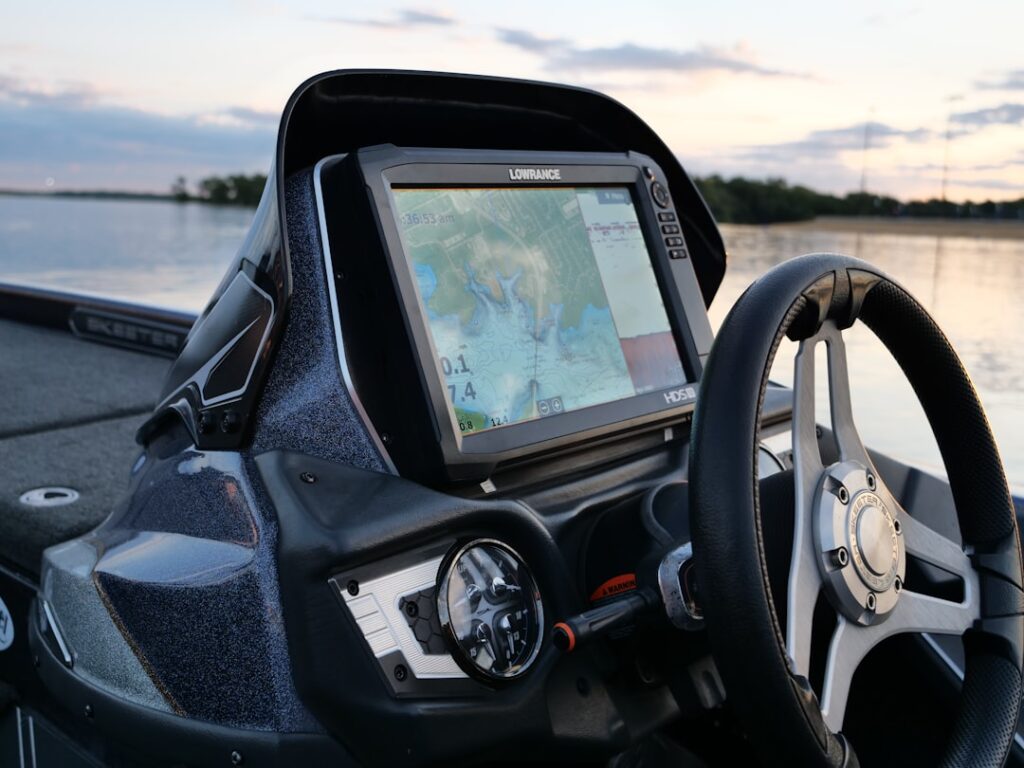
If you regularly run offshore, fish wrecks or want a system that can grow with the boat, step up to a networkable multifunction display. Lowrance HDS PRO is a strong example because it supports CHIRP, SideScan, DownScan, ActiveTarget live sonar and networking. Depending on the connected transducer, Lowrance rates HDS PRO for independent dual 1 kW sonar capability and specifies maximum depth up to 5,000 feet under suitable conditions.
That does not mean every HDS PRO package will read bottom at 5,000 feet. Maximum depth depends heavily on the transducer, installation, frequency, sea conditions and bottom composition. This is exactly why offshore buyers should choose the transducer and display as a system.
Best Fish Finder for Deep Dropping
Deep dropping changes our priorities. When fishing hundreds of feet down, we care more about maintaining a clean traditional sonar return, reading bottom composition and seeing targets near bottom than we do about ultra-high-frequency side imaging. Lower-frequency CHIRP generally penetrates deeper water better, while higher frequencies typically provide greater detail over shallower ranges.
If deep dropping is a major part of your fishing, look for a display that supports a quality offshore CHIRP transducer. Higher-end systems capable of working with 1 kW transducers give anglers considerably more room to build a serious deep-water setup.
Pair your electronics with our Deep Drop Fishing Rigs Guide and our Interactive Florida Keys Fishing Map.
Do You Need Live Sonar in the Florida Keys?
Live sonar is impressive, but we would not make it the first priority for a Florida Keys offshore setup. Garmin LiveScope and Lowrance ActiveTarget can show fish and movement in real time with compatible hardware, but traditional CHIRP, a properly selected transducer and good mapping are more fundamental for most reef, wreck and deep-drop fishing.
If you also sight-fish, work structure closely, fish from a trolling motor or simply want the added capability, live sonar can be a powerful upgrade after the core system is right.
Screen Size: 7 vs. 9 vs. 12 Inches
- 5–7 inches: good for small consoles and basic chart/sonar use.
- 9–10 inches: our favorite general-purpose range because split screens remain easy to read without taking over the console.
- 12 inches and larger: excellent for offshore boats, multi-pane sonar/chart views and anglers who spend long days watching electronics.
If you routinely run chart + traditional sonar + side/down imaging simultaneously, screen size becomes much more valuable than it seems in the store.
Transom Mount vs. Thru-Hull Transducers
Transom-mount transducers are affordable, accessible and common on smaller fishing boats. Installation quality matters: turbulent or aerated water crossing the transducer can hurt sonar performance, especially while running.
Thru-hull transducers require a more involved installation but can be an excellent choice for serious offshore sonar. Hull design, deadrise and installation location matter, so a professional installation is worth considering when moving into expensive offshore transducers.
Features Worth Paying For
- Traditional CHIRP sonar
- Quality coastal mapping
- Side and down imaging for reef and structure searching
- A bright screen that remains readable in Florida sunlight
- NMEA 2000 and networking if you plan to expand the system
- Enough screen size for useful split-screen views
- A transducer specifically suited to your fishing depth and hull
Features You May Not Need to Pay For First
Live sonar, the biggest available screen and every networking accessory are great when they fit the way you fish, but none of them can compensate for a poorly chosen or poorly installed transducer. Put the sonar foundation first.
Our Florida Keys Fish Finder Shopping Shortlist
These are the six fish-finder packages we recommend shopping first. Always confirm the exact screen size, included transducer and chart package on Amazon before ordering because manufacturers sell several versions of the same display.
Garmin ECHOMAP UHD2 74sv — Budget Coastal Pick
A strong starting point for smaller Florida Keys boats when you want coastal mapping, traditional CHIRP and scanning sonar without stepping into a large offshore MFD.
Lowrance Elite FS 9 — Best All-Around Pick
A versatile choice for reef, wreck and general Keys fishing, especially when paired with the correct Active Imaging transducer package.
Garmin ECHOMAP Ultra 2 102sv — Upper Mid-Range Pick
A larger-screen Garmin option for anglers who want excellent split-screen usability, scanning sonar capability and room to expand the system.
Lowrance HDS PRO 10 — Premium Offshore Pick
Our serious offshore/deep-water Lowrance choice. The display has the capability to anchor a much more powerful sonar system when matched with the right offshore transducer.
Simrad NSS — Premium Alternative
A strong alternative for offshore boats, particularly for anglers already building around Simrad marine electronics and compatible sonar hardware.
Humminbird MEGA Side Imaging — Premium Alternative
A good alternative for anglers who prioritize detailed side-imaging capability. Verify the exact Humminbird model and included MEGA SI transducer in the Amazon listing before ordering.
- Budget coastal: Garmin ECHOMAP UHD2-class package or comparable CHIRP/chartplotter.
- All-around: Lowrance Elite FS-class package with an appropriate Active Imaging transducer.
- Upper mid-range: Garmin ECHOMAP Ultra 2-class system.
- Premium offshore: Lowrance HDS PRO-class multifunction display paired with an offshore-capable transducer.
- Alternative premium systems: comparable saltwater units from Simrad and Humminbird, selected primarily by sonar/transducer capability and the boat’s existing electronics ecosystem.
Bottom Line
For most Florida Keys anglers, the best fish finder is not necessarily the most expensive screen. Start with the water you actually fish. For patch reefs and general Keys fishing, a good CHIRP/side/down-imaging combo unit is extremely versatile. For offshore wrecks and deep dropping, move the transducer and traditional CHIRP performance to the top of the list.
Once you have the electronics sorted, use our Florida Keys Tackle Checklist, Fishing Calendar and Interactive Fishing Map to finish planning your trip.