Category: Offshore fishing

  • Florida Keys sailfishing is considered some of the best in the world. Every winter, thousands of sailfish migrate through the Keys, giving anglers an incredible opportunity to target one of the fastest and most exciting gamefish in the ocean.

    Whether you’re trolling, kite fishing, or drifting live bait, understanding where to find sailfish and how they feed can dramatically increase your chances of success.

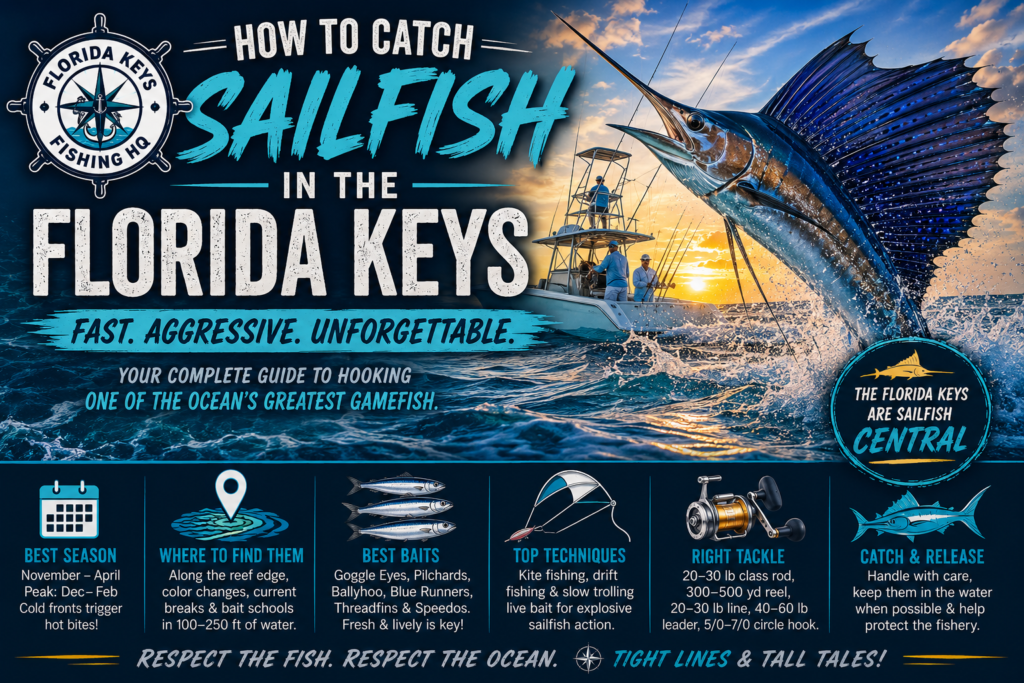
    When Is the Best Time to Catch Sailfish in the Florida Keys?

    The peak sailfish season runs from:

    • November through April
    • Prime months: December, January, and February

    Cold fronts often trigger excellent sailfish action. Many experienced anglers plan trips immediately after a strong front passes through the Keys.

    Where to Find Sailfish in the Florida Keys

    Sailfish are typically found along the edge of the reef line and offshore waters where baitfish concentrate.

    Popular areas include:

    • Key Largo reef edge
    • Islamorada reef line
    • Marathon offshore reefs
    • Upper Keys color changes
    • Current edges along the Gulf Stream

    Most sailfish are caught in:

    • 100–250 feet of water
    • Areas with strong current
    • Locations holding schools of baitfish

    Bird activity, bait schools, and color changes are all signs worth investigating.

    Best Baits for Sailfish

    Live bait consistently produces the most sailfish.

    Top choices include:

    • Goggle Eyes
    • Pilchards
    • Ballyhoo
    • Blue Runners
    • Threadfin Herring
    • Speedos

    Healthy, lively bait is often more important than bait size.

    Best Sailfish Rigs

    Kite Fishing

    Kite fishing is widely considered the most effective sailfish technique in the Florida Keys.

    Benefits include:

    • Keeps bait near the surface
    • Creates natural presentation
    • Allows multiple baits to be fished simultaneously
    • Produces spectacular visual strikes

    Drift Fishing

    Drifting live bait along the reef edge is another productive method.

    This technique works especially well when:

    • Winds are light
    • Current is strong
    • Bait schools are concentrated

    Slow Trolling

    Slow trolling live baits behind the boat can help cover more water when fish are scattered.

    Recommended Tackle

    A typical sailfish setup includes:

    Rod

    • 20–30 lb class conventional rod

    Reel

    • Lever drag conventional reel
    • 300–500 yards of line capacity

    Main Line

    • 20–30 lb monofilament
    • 30–50 lb braid

    Leader

    • 40–60 lb fluorocarbon leader

    Hook

    • 5/0–7/0 circle hook

    Circle hooks improve hook-up rates and reduce injury to released fish.

    How Sailfish Feed

    Sailfish often use their bills to stun baitfish before eating them.

    Signs of feeding activity include:

    • Frigate birds diving
    • Nervous bait schools
    • Flying fish
    • Surface explosions

    When sailfish are actively feeding, action can be fast and exciting.

    Fighting a Sailfish

    Once hooked, sailfish are known for:

    • High-speed runs
    • Spectacular jumps
    • Long fights

    Maintain steady pressure and avoid excessive drag settings.

    Most Florida Keys anglers release sailfish to help preserve this incredible fishery.

    Tips for More Sailfish

    • Fish after cold fronts.
    • Focus on active bait schools.
    • Watch for bird activity.
    • Use fresh, lively bait.
    • Stay mobile if fish are not showing.
    • Pay attention to current breaks and color changes.

    Small adjustments can make a huge difference during a sailfish bite.

    Final Thoughts

    Sailfish are one of the most exciting fish you can target in the Florida Keys. Their speed, acrobatics, and aggressive strikes create unforgettable experiences for anglers of all skill levels.
  • Deep drop fishing in the Florida Keys offers anglers the opportunity to catch some of the most prized fish in the Atlantic Ocean. Species such as snowy grouper, queen snapper, yellowedge grouper, tilefish, blackbelly rosefish, and barrelfish can all be found in the deep waters off the Keys.

    The secret isn’t having someone’s coordinates. The most successful deep drop fishermen learn how to identify productive bottom structure and locate areas where deep-water species naturally gather.

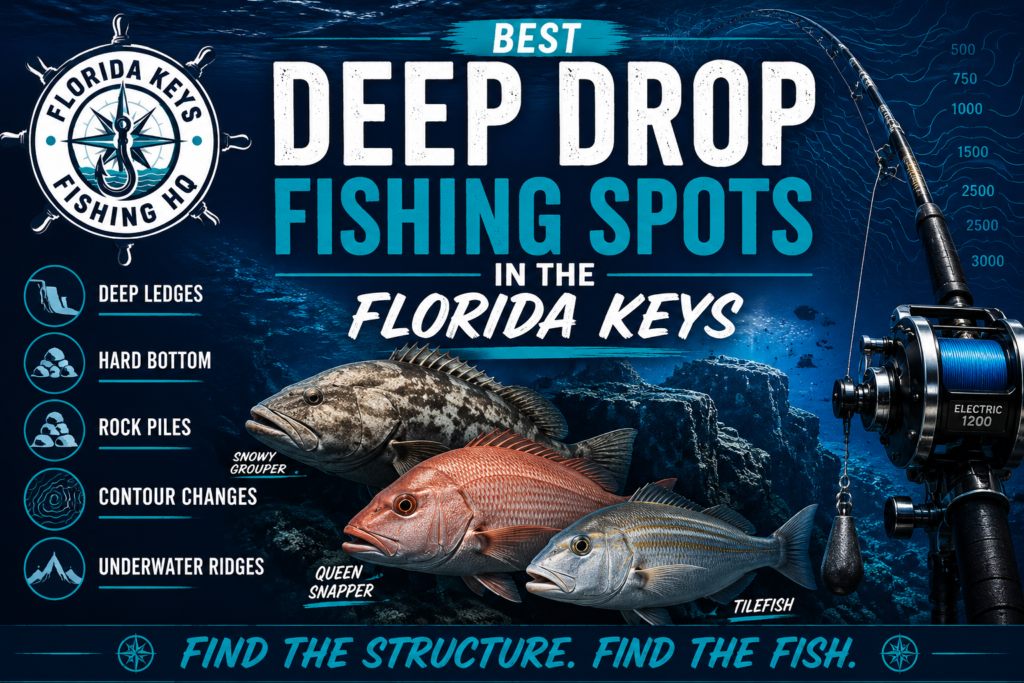
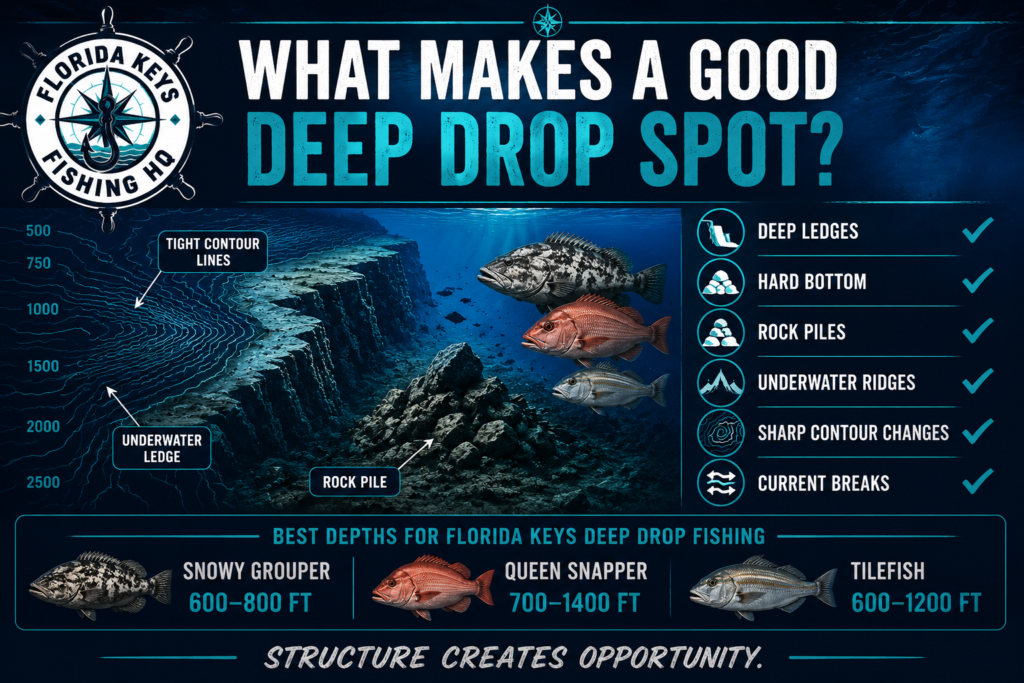
    The best deep drop fishing spots share several characteristics:

    • Sharp contour changes
    • Deep ledges
    • Rock piles
    • Hard bottom
    • Underwater ridges
    • Canyons and drop-offs
    • Areas with strong current flow

    These features create feeding opportunities and provide habitat for deep-water species.

    Productive Depth Ranges

    Different species are commonly found at different depths.

    SpeciesTypical Depth
    Snowy Grouper600-800 ft
    Queen Snapper700-1400 ft
    Tilefish600-1200 ft
    Blackbelly Rosefish700-1200 ft
    Yellowedge Grouper700-1200 ft
    Barrelfish800-1500 ft

    Always pay attention to the depth where fish are caught and search for similar structure nearby.

    The Edge of the Continental Shelf

    One of the most productive deep drop areas in the Florida Keys is the edge of the continental shelf.

    As the bottom drops from several hundred feet into much deeper water, underwater ledges and contour breaks are formed. These structures concentrate bait and attract predators.

    Many successful deep drop fishermen focus their efforts along these transitions rather than fishing flat bottom.

    Look for Contour Changes

    One of the easiest ways to find potential deep drop spots is by studying contour lines on Navionics.

    Areas where contour lines are tightly packed together indicate steep bottom changes.

    These areas often hold:

    • Snowy Grouper
    • Queen Snapper
    • Tilefish
    • Yellowedge Grouper

    The steeper the change, the more likely fish are to use the area.

    Rock Piles and Hard Bottom

    Deep-water species frequently gather around isolated rock piles and hard-bottom areas.

    These locations provide:

    • Food
    • Current breaks
    • Ambush points
    • Protection

    Even a small rock pile can hold multiple fish when surrounded by otherwise featureless bottom.

    How to Find Deep Drop Spots Using Navionics

    Navionics is one of the most valuable tools for locating productive deep drop areas.

    Look for:

    • Sharp contour changes
    • Fingers extending into deeper water
    • Underwater points
    • Isolated humps
    • Deep ledges
    • Areas where contours bend sharply

    Spend time studying maps before leaving the dock. Finding good structure is often more important than having exact coordinates.

    Drift or Anchor?

    Most anglers drift when deep dropping.

    Drifting allows you to:

    • Cover more ground
    • Locate active fish
    • Search new structure

    Anchoring can be effective when fish are concentrated on a small area, but it is often more difficult in deep water with strong current.

    Species Commonly Caught While Deep Dropping

    Deep drop anglers in the Florida Keys regularly catch:

    • Snowy Grouper
    • Queen Snapper
    • Tilefish
    • Blackbelly Rosefish
    • Yellowedge Grouper
    • Barrelfish
    • Misty Grouper
    • Silk Snapper

    Multiple species may be caught from the same piece of structure.

    Final Thoughts

    The best deep drop fishing spots in the Florida Keys are rarely defined by a single GPS coordinate. Instead, successful anglers learn to identify productive bottom structure, study contour lines, and focus on areas where deep-water species naturally live and feed.

    By targeting ledges, hard bottom, underwater ridges, and major contour changes, you can consistently locate fish and develop your own collection of productive deep drop spots.

    Associated Articles

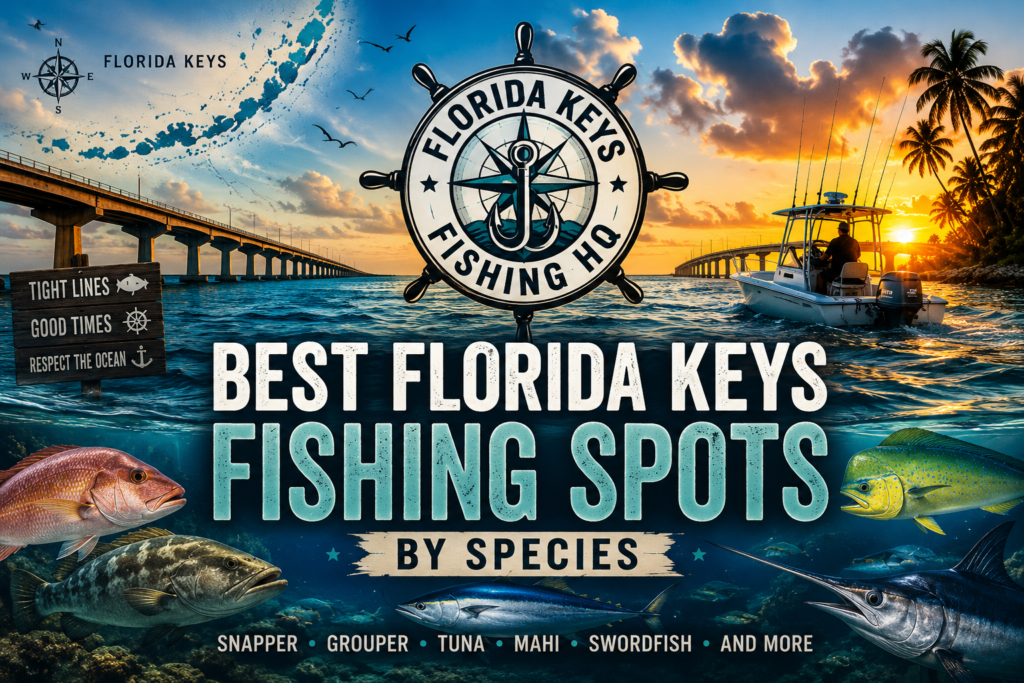
  • Best Florida Keys Fishing Spots by Species (2026 Guide)

    The Florida Keys offer some of the best fishing opportunities in the world. From shallow-water mangrove snapper to deep-water snowy grouper and swordfish, knowing where each species lives can dramatically increase your success.

    This guide breaks down the best Florida Keys fishing spots by species and explains the types of structure, depths, and areas that consistently produce fish throughout the Keys.

    Mangrove Snapper

    Mangrove snapper can be found throughout the Florida Keys and are one of the most popular species for both boat and shore anglers.

    Best Areas

    • Bridges
    • Mangrove shorelines
    • Residential canals
    • Patch reefs
    • Artificial reefs

    Typical Depth

    • 5 to 120 feet

    What to Look For

    Current flow, structure, dock pilings, bridge pilings, and rocky bottom.

    Related Guide: Mangrove Snapper Fishing Guide (2026 Florida Keys Edition)

    Yellowtail Snapper

    Yellowtail snapper are commonly targeted along the reef tract and respond extremely well to a steady chum slick.

    Best Areas

    • Outer reef edge
    • Coral reefs
    • Patch reefs
    • Reef drop-offs

    Typical Depth

    • 20 to 120 feet

    What to Look For

    Clean water, current, and active chum lines.

    Related Guide: Yellowtail Snapper Fishing in the Florida Keys (2026 Guide)

    Mutton Snapper

    Mutton snapper are prized for their size and fighting ability.

    Best Areas

    • Offshore wrecks
    • Reef edges
    • Gravel bottoms
    • Hard-bottom areas

    Typical Depth

    • 50 to 250 feet

    What to Look For

    Structure near sandy areas and strong current.

    Black Grouper

    Black grouper prefer heavy structure and often stay close to reefs and wrecks.

    Best Areas

    • Natural reefs
    • Artificial reefs
    • Deep ledges
    • Shipwrecks

    Typical Depth

    • 40 to 300 feet

    What to Look For

    Large rocks, ledges, and reef systems.

    Related Guide: Black Grouper Fishing in the Florida Keys (2026 Guide)

    Gag Grouper

    Gag grouper are often found on deeper structure and rocky bottom.

    Best Areas

    • Offshore ledges
    • Deep reefs
    • Artificial reefs

    Typical Depth

    • 80 to 300 feet

    What to Look For

    Bottom relief and hard structure.

    Related Guide: Gag Grouper Fishing in the Florida Keys (2026 Guide)

    Snowy Grouper

    Snowy grouper are a favorite target for deep drop anglers fishing offshore from Key Largo and the Upper Keys.

    Best Areas

    • Deep contour edges
    • Offshore ledges
    • Bottom structure in deep water

    Typical Depth

    • 600 to 1,200 feet

    What to Look For

    Sharp contour changes, isolated bottom structure, and hard bottom.

    Related Guides:

    • How to Find Snowy Grouper in the Florida Keys (2026 Guide)
    • Best Snowy Grouper Rig Setup (2026 Guide)

    Queen Snapper

    Queen snapper inhabit deeper offshore waters and are commonly caught while deep dropping.

    Best Areas

    • Deep offshore structure
    • Bottom ledges
    • Steep drop-offs

    Typical Depth

    • 600 to 1,500 feet

    What to Look For

    Deep structure near contour changes.

    Related Guide: Queen Snapper Fishing in the Florida Keys (2026 Guide)

    Tilefish

    Tilefish live in deep offshore waters and are often targeted alongside snowy grouper and queen snapper.

    Best Areas

    • Mud bottoms
    • Deep contour lines
    • Offshore drop-offs

    Typical Depth

    • 600 to 1,500 feet

    What to Look For

    Soft bottom adjacent to structure.

    Related Guide: Tilefish Fishing in the Florida Keys (2026 Guide)

    Swordfish

    The Florida Keys are one of the best places in the world to target daytime swordfish.

    Best Areas

    • Gulf Stream edge
    • Deep offshore canyons
    • Steep drop-offs

    Typical Depth

    • 1,200 to 2,000 feet

    What to Look For

    Temperature breaks, current edges, and bottom contour changes.

    Related Guide: Swordfish Fishing in the Florida Keys (2026 Guide)

    Blackfin Tuna

    Blackfin tuna are highly migratory and often feed around current breaks and offshore structure.

    Best Areas

    • Offshore humps
    • Reef edge
    • Current rips

    Typical Depth

    • Surface to 300 feet

    What to Look For

    Bird activity, bait schools, and current lines.

    Related Guide: Blackfin Tuna Fishing in the Florida Keys (2026 Guide)

    Mahi-Mahi

    Mahi are one of the most exciting offshore species available in the Keys.

    Best Areas

    • Weed lines
    • Floating debris
    • Current edges

    Typical Depth

    • Surface waters offshore

    What to Look For

    Sargassum weed, birds, and floating structure.

    Related Guide: Mahi-Mahi Fishing in the Florida Keys (2026 Guide)

    Final Thoughts

    The best Florida Keys fishing spots depend on the species you are targeting. Whether you’re fishing bridges for mangrove snapper, reefs for yellowtail, or dropping in 1,000 feet of water for snowy grouper and queen snapper, understanding habitat and structure is the key to success.

    Before heading out, always review current regulations, weather conditions, and seasonal closures. With the right location and setup, the Florida Keys can provide world-class fishing opportunities year-round.

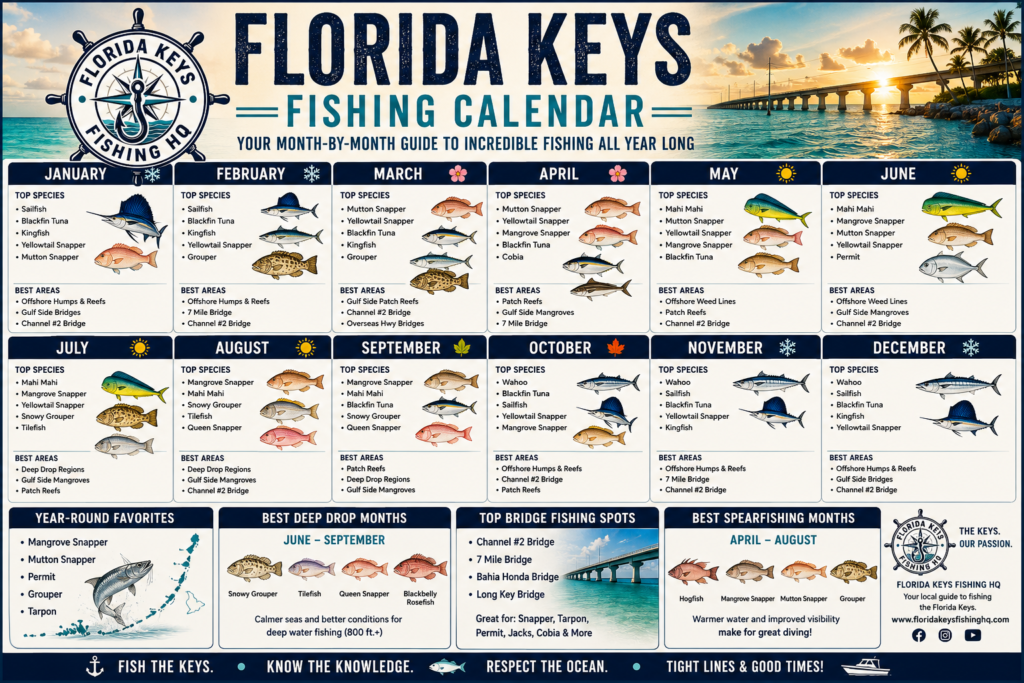
  • Florida Keys Fishing Calendar (2026 Guide)

    Introduction

    The Florida Keys offer world-class fishing opportunities throughout the year. While some species are available year-round, others have peak seasons when fishing is at its best. Understanding what fish are most active each month can help anglers plan successful trips and target the species they want most.

    This Florida Keys Fishing Calendar provides a month-by-month overview of some of the most popular game fish found throughout the Keys.

    Top Species:

    • Blackfin Tuna
    • Sailfish
    • Kingfish
    • Yellowtail Snapper
    • Mutton Snapper

    Winter cold fronts often produce excellent offshore fishing conditions, especially for sailfish and blackfin tuna.

    Top Species:

    • Sailfish
    • Blackfin Tuna
    • Kingfish
    • Yellowtail Snapper
    • Grouper

    February continues to provide some of the best offshore action of the year.

    Top Species:

    • Mutton Snapper
    • Yellowtail Snapper
    • Blackfin Tuna
    • Kingfish
    • Grouper

    As water temperatures begin to rise, snapper fishing often improves significantly.

    Top Species:

    • Mutton Snapper
    • Yellowtail Snapper
    • Mangrove Snapper
    • Blackfin Tuna
    • Cobia

    Spring fishing can be outstanding throughout the Florida Keys.

    Top Species:

    • Mahi-Mahi
    • Mutton Snapper
    • Yellowtail Snapper
    • Mangrove Snapper
    • Blackfin Tuna

    May marks the beginning of excellent mahi-mahi fishing offshore.

    Top Species:

    • Mahi-Mahi
    • Mangrove Snapper
    • Mutton Snapper
    • Yellowtail Snapper
    • Permit

    June is one of the most productive months for a variety of species.

    Top Species:

    • Mahi-Mahi
    • Mangrove Snapper
    • Yellowtail Snapper
    • Snowy Grouper
    • Tilefish

    Summer weather often allows anglers to access deeper offshore waters.

    Top Species:

    • Mangrove Snapper
    • Mahi-Mahi
    • Snowy Grouper
    • Tilefish
    • Queen Snapper

    Deep drop fishing is often excellent during calm summer conditions.

    Top Species:

    • Mangrove Snapper
    • Mahi-Mahi
    • Blackfin Tuna
    • Snowy Grouper
    • Queen Snapper

    Many anglers enjoy lighter fishing pressure during September.

    Top Species:

    • Wahoo
    • Blackfin Tuna
    • Sailfish
    • Yellowtail Snapper
    • Mangrove Snapper

    Cooling water temperatures begin to bring more pelagic species into the area.

    Top Species:

    • Wahoo
    • Sailfish
    • Blackfin Tuna
    • Yellowtail Snapper
    • Kingfish

    November is often considered one of the best months for wahoo fishing.

    Top Species:

    • Wahoo
    • Sailfish
    • Blackfin Tuna
    • Kingfish
    • Yellowtail Snapper

    Winter fishing patterns return and offshore action can be outstanding.

    Best Deep Drop Fishing Months

    Many anglers target deep-water species year-round, but some of the most productive months include:

    • June
    • July
    • August
    • September

    These months often provide calmer seas and more opportunities to fish depths exceeding 800 feet.

    Popular deep drop species include:

    • Snowy Grouper
    • Tilefish
    • Queen Snapper
    • Blackbelly Rosefish

    Best Spearfishing Months

    While spearfishing can be productive year-round, many divers prefer:

    • April
    • May
    • June
    • July
    • August

    These months often offer warmer water and improved visibility.

    Popular targets include:

    • Hogfish
    • Mangrove Snapper
    • Mutton Snapper
    • Grouper

    Final Thoughts

    There is no bad time to fish in the Florida Keys. Every month offers opportunities to target different species, from offshore pelagics and reef fish to deep drop species and inshore favorites.

    Understanding seasonal patterns can help anglers maximize their success and plan trips around their preferred target species.

    Related Florida Keys Fishing Guides

    Planning your next fishing trip? Check out these helpful guides:

    Wahoo Fishing in the Florida Keys (2026 Guide)

    Learn when and where to target one of the fastest fish in the ocean.

    Mahi-Mahi Fishing in the Florida Keys (2026 Guide)

    Discover the best seasons, locations, and techniques for catching mahi.

    Snowy Grouper Fishing in the Florida Keys (2026 Guide)

    Explore one of the Keys’ premier deep drop species.

    Mangrove Snapper Fishing in the Florida Keys (2026 Guide)

    Learn how to consistently catch mangrove snapper throughout the year.

    Best Florida Keys Bridges for Fishing (2026 Guide)

    Find productive bridge fishing locations throughout the Keys.

  • Introduction

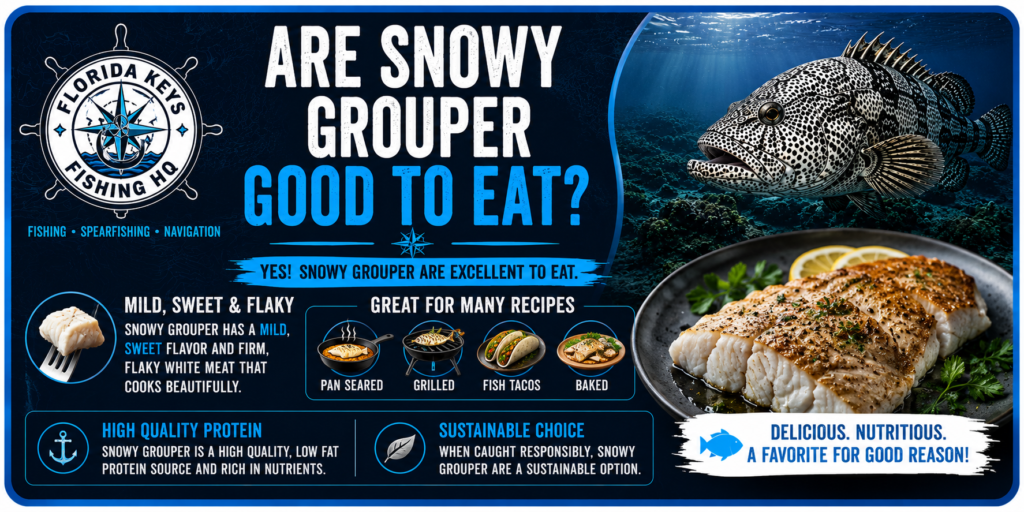
    Snowy grouper are among the most sought-after deep drop species in the Florida Keys. Found in depths ranging from 600 to over 1,200 feet, these hard-fighting grouper are known for their excellent table fare and year-round availability. Anglers willing to fish deep water can consistently target snowy grouper around ledges, hard bottom, and offshore structure throughout the Keys.

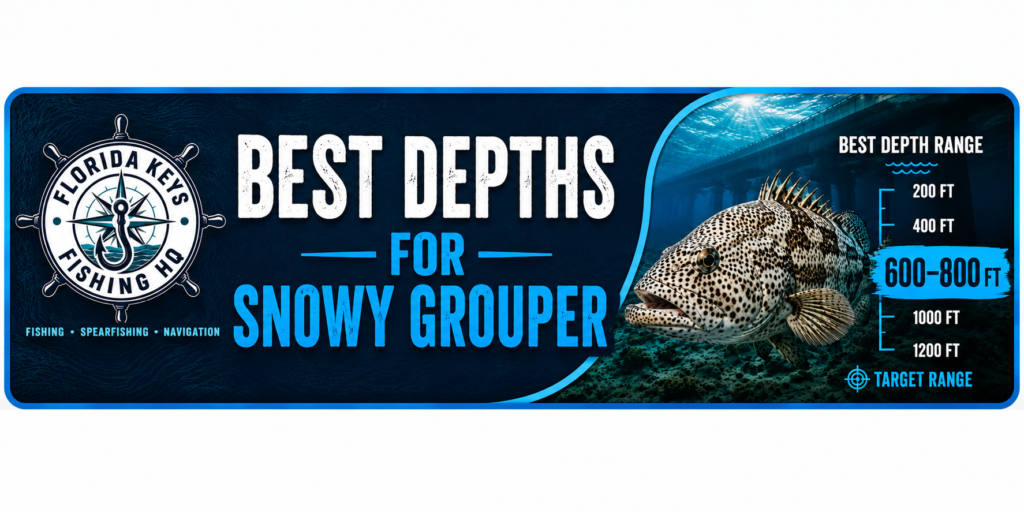
    Most snowy grouper in the Florida Keys are caught between:

    • 600–800 feet
    • 800–1,000 feet
    • 1,000–1,200 feet

    Larger fish are often found deeper.

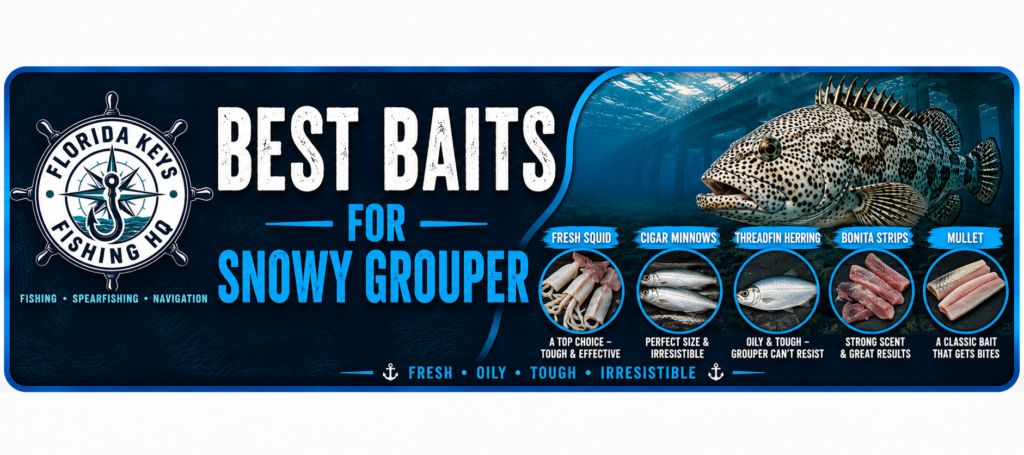
    Top baits include:

    • Bonita strips
    • Squid
    • Mackerel strips
    • Blue runner chunks
    • Threadfin Herring
    • Mullet
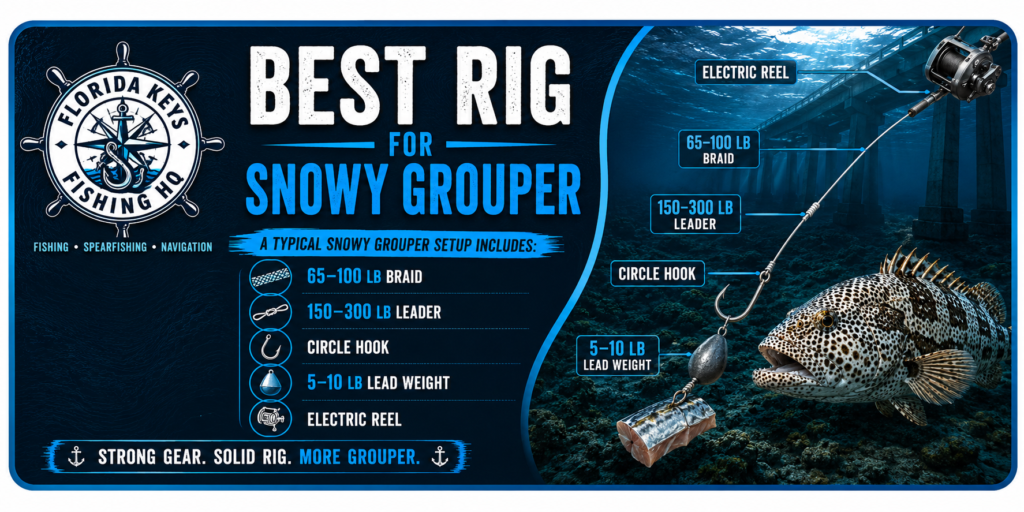
    • 65–100 lb braid
    • 150–300 lb leader
    • Circle hook
    • 5–10 lb lead weight
    • Electric reel

    For a complete rig breakdown, see our Best Snowy Grouper Rig Setup (2026 Guide).

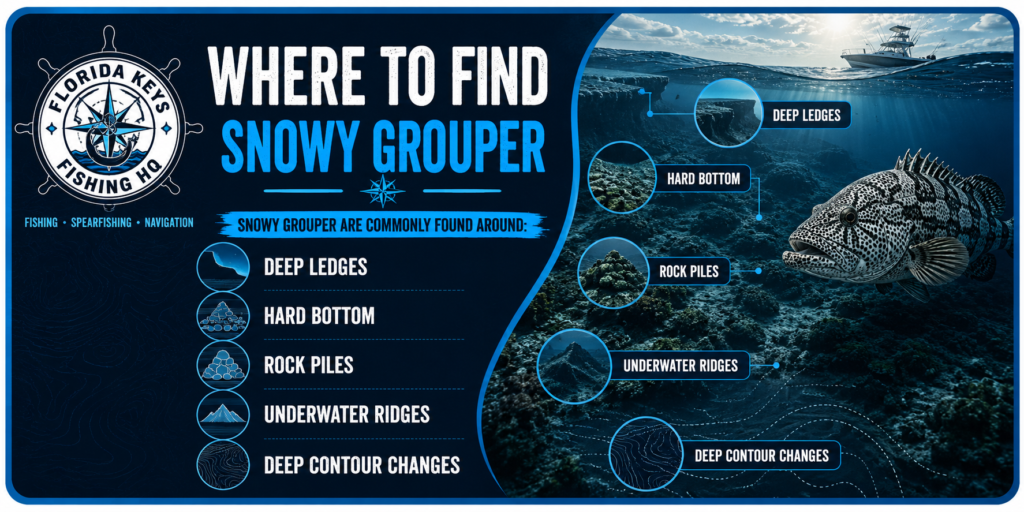
    Snowy grouper are commonly found around:

    • Deep ledges
    • Hard bottom
    • Rock piles
    • Underwater ridges
    • Deep contour changes

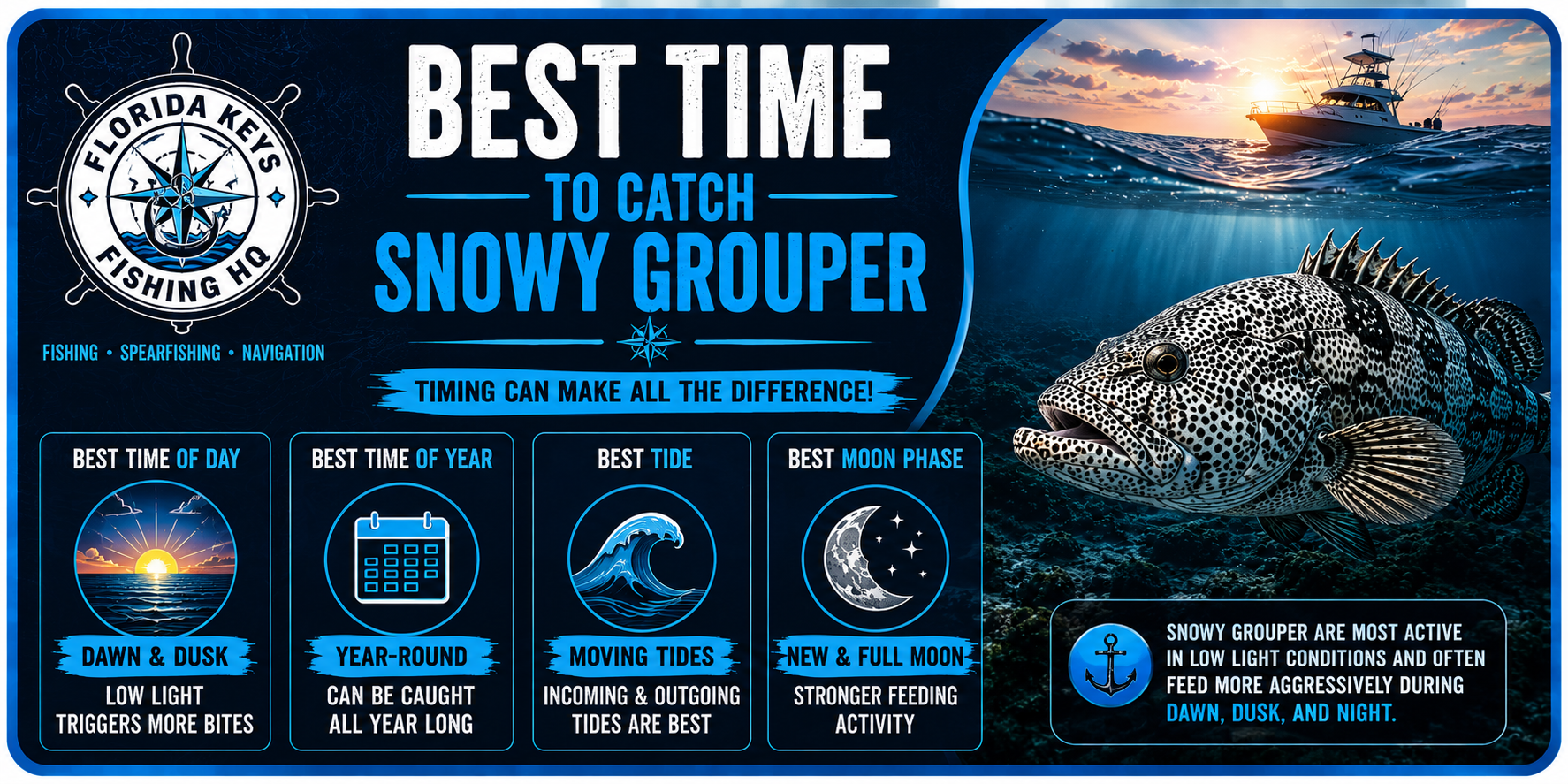
    Snowy groupers can be caught year-round. Success often depends more on current and drift conditions than the season.

    Many anglers consider snowy grouper among the best-eating fish in the Florida Keys. Their white, firm fillets are excellent grilled, baked, or fried.

    Final Thoughts

    Snowy grouper are one of the premier deep drop targets in the Florida Keys. By fishing deep structure with quality tackle and fresh bait, anglers can consistently catch these prized fish throughout the year.

    Related Florida Keys Deep Drop Fishing Guides

    If you’re interested in targeting snowy grouper, these guides can help you catch more fish and locate productive deep-water structure throughout the Florida Keys:

    How to Find Snowy Grouper in the Florida Keys (2026 Guide)

    Learn how to identify productive ledges, hard bottom, and contour changes using Navionics and other mapping tools to consistently locate snowy grouper offshore.

    Best Snowy Grouper Rig Setup (2026 Guide)

    Discover the tackle, leader setup, hook selection, and weight recommendations that work best when targeting snowy grouper in 600–1,200 feet of water.

    Deep Drop Fishing Rigs Explained (2026 Guide)

    New to deep dropping? This guide breaks down the most effective deep drop rigs for grouper, snapper, tilefish, and other deep-water species found in the Florida Keys.

    Best Deep Drop Reels for Florida Keys Fishing (2026 Guide)

    Compare the top electric reels used by Florida Keys anglers and learn which models are best suited for deep-water fishing.

    How to Use Navionics to Find Deep Drop Fishing Spots (2026 Guide)

    Learn how to read contour lines, identify underwater structure, and find productive deep drop locations using Navionics charts.

    Queen Snapper Fishing in the Florida Keys (2026 Guide)

    Once you’ve mastered snowy grouper fishing, queen snapper are another excellent deep-water target often found in similar offshore environments.

  • Introduction

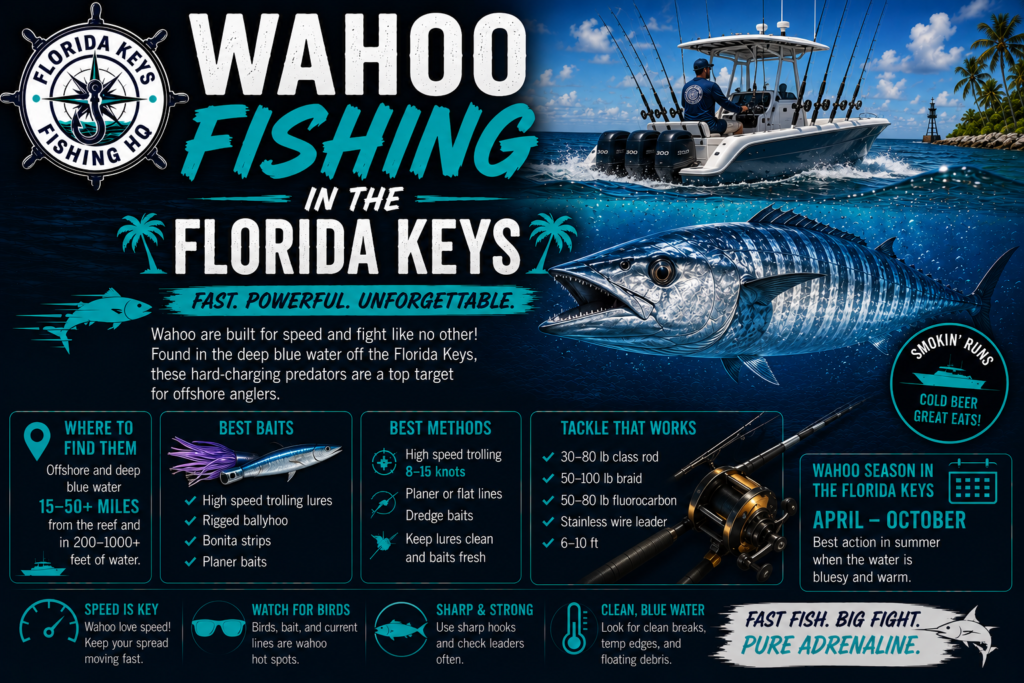
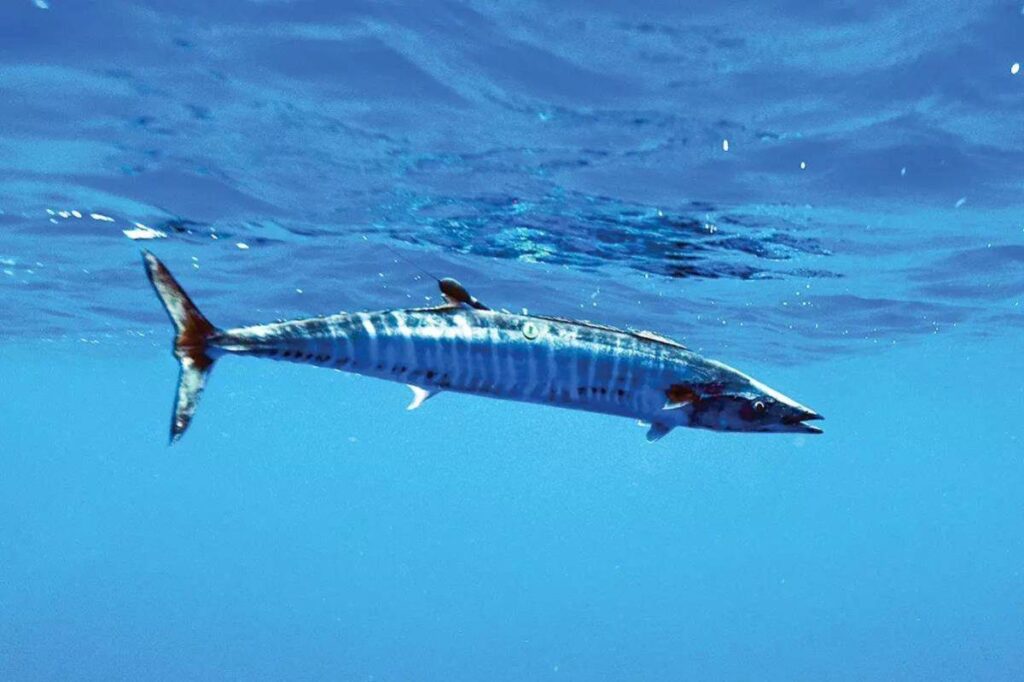
    Wahoo are one of the fastest and most exciting game fish found in the Florida Keys. Known for blistering runs, razor-sharp teeth, and outstanding table fare, wahoo are a favorite target among offshore anglers throughout the year.

    While wahoo can be caught year-round, the best fishing often occurs during the cooler months when fish migrate through the Keys and patrol reef edges, offshore ledges, wrecks, and temperature breaks.

    Where to Find Wahoo in the Florida Keys

    Wahoo are highly migratory fish that spend most of their time offshore.

    Productive areas include:

    • Reef edges
    • Offshore drop-offs
    • Deep wrecks
    • Current breaks
    • Color changes
    • Weed lines

    Many anglers target wahoo in waters ranging from 120 to 1,000 feet deep, depending on conditions.

    Best Time to Catch Wahoo

    Wahoo fishing is generally best from:

    • October through March

    Peak months often include:

    • November
    • December
    • January

    Strong currents, cold fronts, and rougher seas frequently trigger excellent wahoo action.

    Best Trolling Speed for Wahoo

    Wahoo prefer fast-moving baits.

    Most successful anglers troll between:

    • 8 and 15 knots

    High-speed trolling allows anglers to cover large areas and locate active fish.

    Best Wahoo Lures

    Top-producing lures include:

    • High-speed trolling lures
    • Bullet heads
    • Jet heads
    • Islander-style lures
    • Weighted skirted lures

    Popular colors:

    • Blue and white
    • Black and purple
    • Pink and silver
    • Orange and black

    Many anglers run larger lures specifically designed for high-speed trolling.

    Best Natural Baits for Wahoo

    Wahoo also respond well to natural baits.

    Popular choices include:

    • Ballyhoo
    • Bonito strips
    • Mullet
    • Speedos
    • Small tuna

    Rigged ballyhoo remains one of the most productive natural presentations in the Florida Keys.

    Wahoo Trolling Setup

    A typical setup includes:

    • 50 to 80 lb class rods
    • High-capacity conventional reels
    • 50 to 80 lb braid or monofilament
    • Wire leaders
    • High-speed trolling lures

    Because of their sharp teeth, wire leaders are essential.

    Finding Productive Water

    Successful wahoo anglers look for:

    • Temperature breaks
    • Current edges
    • Bait schools
    • Bird activity
    • Structure near deep water

    Electronics and charting software can help identify productive offshore areas.

    Wahoo Around the Full Moon

    Many experienced Florida Keys anglers believe some of the best wahoo fishing occurs around:

    • Full moon periods
    • New moon periods

    These moon phases often increase feeding activity and improve fishing success.

    Why Wahoo Are So Popular

    Wahoo are prized because they:

    • Fight extremely hard
    • Reach speeds exceeding 50 mph
    • Produce excellent table fare
    • Can grow over 100 pounds
    • Are available throughout much of the year

    Many offshore anglers consider wahoo one of the premier game fish in the Florida Keys.

    Common Mistakes

    Many anglers struggle because they:

    • Troll too slowly
    • Ignore current breaks
    • Use leaders that are too light
    • Fish away from bait concentrations
    • Fail to cover enough water

    Wahoo fishing often rewards anglers who stay mobile and focus on locating active fish.

    Final Thoughts

    Wahoo are among the most exciting offshore species available in the Florida Keys. By focusing on reef edges, offshore structure, current breaks, and bait concentrations, anglers can consistently target these powerful predators. Whether high-speed trolling artificial lures or pulling rigged ballyhoo, wahoo provide some of the fastest action and best table fare found anywhere in Florida waters.

    Related Offshore Fishing Articles

    Be sure to check out these related guides:

  • Introduction

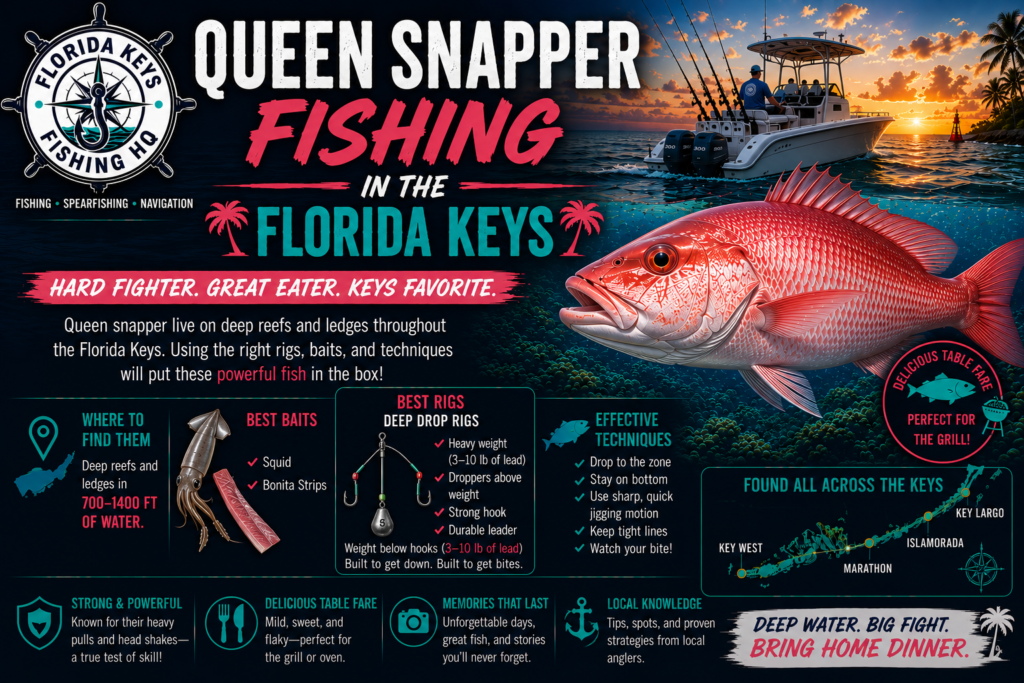
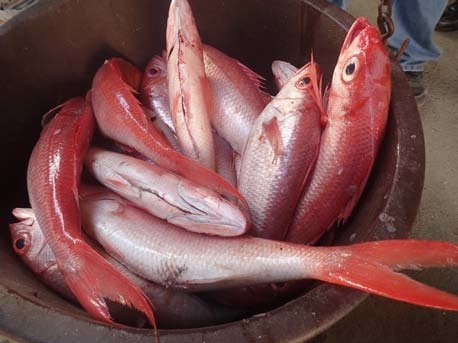
    Queen snapper are one of the most colorful and highly prized deep-water fish found in the Florida Keys. Living in depths ranging from 600 to over 1,500 feet, these beautiful red and orange fish are a favorite target for deep-drop anglers looking to bring home excellent table fare.

    Although not as commonly caught as snowy grouper or tilefish, anglers targeting productive deep-water structure can encounter impressive queen snapper throughout the Keys.

    Where to Find Queen Snapper in the Florida Keys

    Queen snapper are typically found on:

    • Deep ledges
    • Drop-offs
    • Rocky bottom structure
    • Submarine canyons
    • Deep contour changes

    Most successful catches occur in:

    • 700 to 1,400 feet of water
    • Areas with significant depth changes
    • Hard bottom surrounded by softer bottom
    • Deep offshore structure along the edge of the Florida Straits

    Many anglers discover productive queen snapper areas while targeting snowy grouper and tilefish.

    Best Depth for Queen Snapper

    The most productive depths are usually:

    • 700–1,000 feet during cooler months
    • 900–1,500 feet during warmer months

    Current strength often determines where fish will hold on a particular day.

    How to Find Queen Snapper

    Using modern electronics and charting software is critical.

    Look for:

    • Sharp contour changes
    • Ledges
    • Isolated hard-bottom areas
    • Deep ridges
    • Areas holding bait schools

    Many experienced anglers use Navionics and side-by-side sonar mapping to identify productive deep-water structure.

    Best Rig for Queen Snapper

    A standard deep-drop chicken rig works extremely well.

    Recommended Setup

    • 100–150 lb monofilament leader
    • Three-hook chicken rig
    • 8/0 to 10/0 circle hooks
    • Glow beads
    • Glow tubing
    • 5–10 lb sinker depending on current

    Glow components are especially effective in the depths where queen snapper live.

    Best Baits for Queen Snapper

    Top producers include:

    • Squid
    • Bonito strips
    • Tuna belly
    • Barracuda strips
    • Fresh fish chunks
    • Mackerel strips

    Fresh bait generally produces better results than frozen bait.

    Best Time to Catch Queen Snapper

    Queen snapper can be caught year-round.

    Fishing is often best when:

    • Current is manageable
    • Seas are calm
    • Water clarity is good

    Winter and spring often provide some of the most favorable deep-drop conditions.

    Electric Reels and Deep Dropping

    Most anglers use electric reels when targeting queen snapper due to the extreme depths involved.

    Popular choices include:

    • Daiwa Tanacom
    • Banax Kaigen
    • Shimano Beastmaster

    Electric reels allow anglers to fish more efficiently and spend more time with baits on the bottom.

    Why Queen Snapper Are Special

    Queen snapper are highly valued because they:

    • Have excellent table fare
    • Fight surprisingly hard from deep water
    • Are relatively uncommon
    • Feature beautiful coloration
    • Often school around productive structure

    Many deep-drop fishermen consider a large queen snapper one of the most rewarding catches in the Florida Keys.

    Common Mistakes

    Many anglers fail to catch queen snapper because they:

    • Fish too shallow
    • Use sinkers that are too light
    • Ignore contour changes
    • Drift too quickly
    • Fail to keep rigs vertical

    Success often comes from carefully targeting deep structure and maintaining excellent bottom contact.

    Final Thoughts

    Queen snapper are one of the hidden gems of Florida Keys deep-drop fishing. Anglers willing to fish depths of 700 to 1,500 feet can encounter these beautiful fish while targeting snowy grouper, tilefish, and other deep-water species. By focusing on productive structure, using quality electronics, and presenting fresh bait with properly rigged deep-drop tackle, anglers can consistently add queen snapper to their catch.

    Related Deep Drop Fishing Articles

    Looking to improve your deep drop fishing success in the Florida Keys? Be sure to check out these related guides:

    Combining quality electronics, productive structure, fresh bait, and properly rigged tackle can dramatically improve your success when targeting queen snapper and other deep-water fish in the Florida Keys.

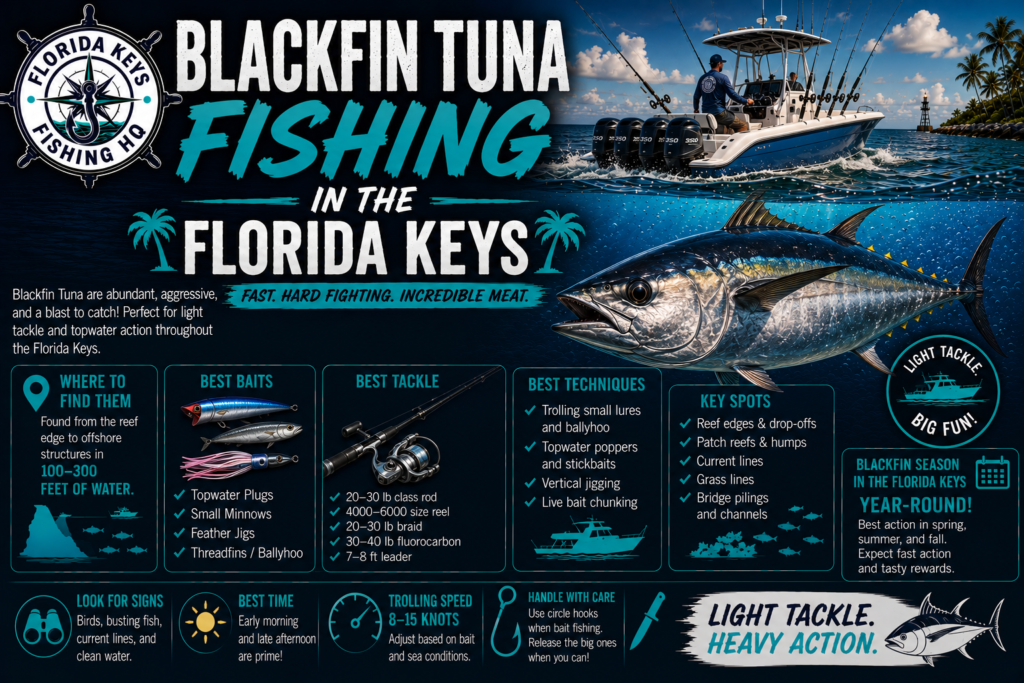
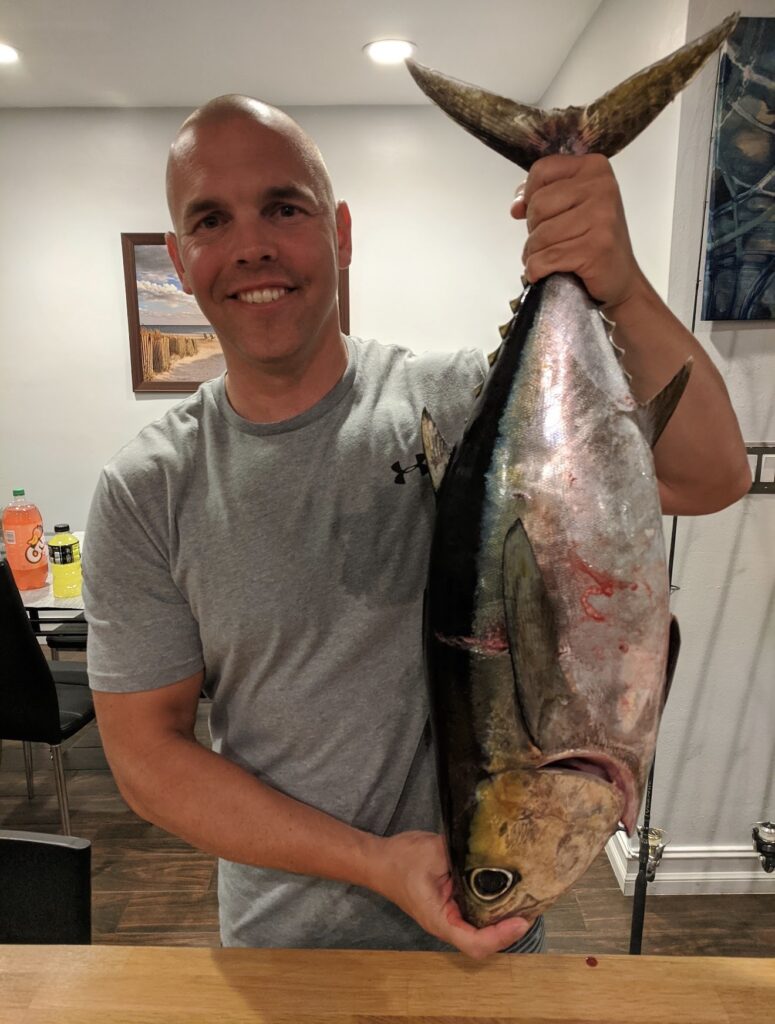
  • Blackfin tuna are one of the most exciting offshore species found in the Florida Keys. Known for their speed, powerful runs, and outstanding table fare, blackfin tuna are a favorite target for anglers fishing offshore waters throughout the year.

    While they are the smallest tuna species found in the Atlantic, blackfin tuna provide incredible sport on both spinning and conventional tackle.

    Where to Find Blackfin Tuna

    Blackfin tuna are commonly found offshore in deeper water where bait is concentrated.

    Productive areas often include:

    • Offshore humps
    • Deep reef edges
    • Current breaks
    • Color changes
    • Areas with bait schools
    • Offshore wrecks and structure

    Many successful anglers focus on areas where strong current pushes bait across underwater structure.

    Best Time of Year for Blackfin Tuna

    Blackfin tuna can be caught year-round in the Florida Keys, but the best fishing often occurs during:

    • Winter
    • Early Spring

    Many anglers consider December through April to be peak blackfin season.

    During these months, schools of tuna frequently gather around offshore humps and bait-rich areas.

    Best Bait for Blackfin Tuna

    Blackfin tuna feed aggressively on small baitfish and squid.

    Top bait choices include:

    • Live pilchards
    • Threadfin herring
    • Ballyhoo
    • Squid
    • Small live baitfish

    Fresh bait often produces excellent results when tuna are feeding near the surface.

    Best Lures for Blackfin Tuna

    Artificial lures can be highly effective.

    Popular options include:

    • Feather jigs
    • Tuna feathers
    • Small skirted trolling lures
    • Metal jigs
    • Soft plastic swimbaits

    Matching the size of local baitfish often increases success.

    Trolling for Blackfin Tuna

    Trolling is one of the most productive methods for locating blackfin tuna.

    Many anglers troll:

    • Small feathers
    • Skirted ballyhoo
    • Cedar plugs
    • Small tuna lures

    around offshore humps and current breaks.

    Maintaining a consistent trolling speed and covering productive water can dramatically improve results.

    Vertical Jigging for Blackfin Tuna

    Vertical jigging has become increasingly popular among tuna anglers.

    When fish are located on sonar:

    • Drop metal jigs to the desired depth
    • Work the jig aggressively through the water column
    • Watch for fish marks and bait schools

    This technique often produces excellent results when tuna are feeding below the surface.

    Finding Birds and Bait

    Bird activity can provide valuable clues when searching for tuna.

    Look for:

    • Diving birds
    • Surface bait schools
    • Breaking fish
    • Nervous water

    Blackfin tuna frequently push bait toward the surface where birds become active.

    Tips for Catching More Blackfin Tuna

    • Keep live bait ready.
    • Watch your electronics closely.
    • Pay attention to current edges.
    • Match lure size to local bait.
    • Slow down when approaching bird activity.
    • Stay near bait concentrations.

    Success often comes from finding the bait first.

    Common Mistakes

    Many anglers:

    • Troll through fish too quickly.
    • Ignore smaller bait schools.
    • Use oversized lures.
    • Leave productive water prematurely.
    • Fail to monitor sonar carefully.

    Patience and observation are often critical when targeting tuna.

    Final Thoughts

    Blackfin tuna provide some of the most exciting offshore fishing available in the Florida Keys. By focusing on bait, birds, current breaks, and offshore structure, anglers can dramatically improve their chances of success.

    Whether trolling offshore of Key Largo, jigging near Islamorada humps, or chasing bird activity beyond Marathon, blackfin tuna remain one of the most rewarding species available to Florida Keys

    Looking for another exciting offshore species? Check out our Mahi-Mahi Fishing in the Florida Keys (2026 Guide).

    and

    Learn when offshore fishing is best in our Florida Keys Fishing Seasons Guide (2026).

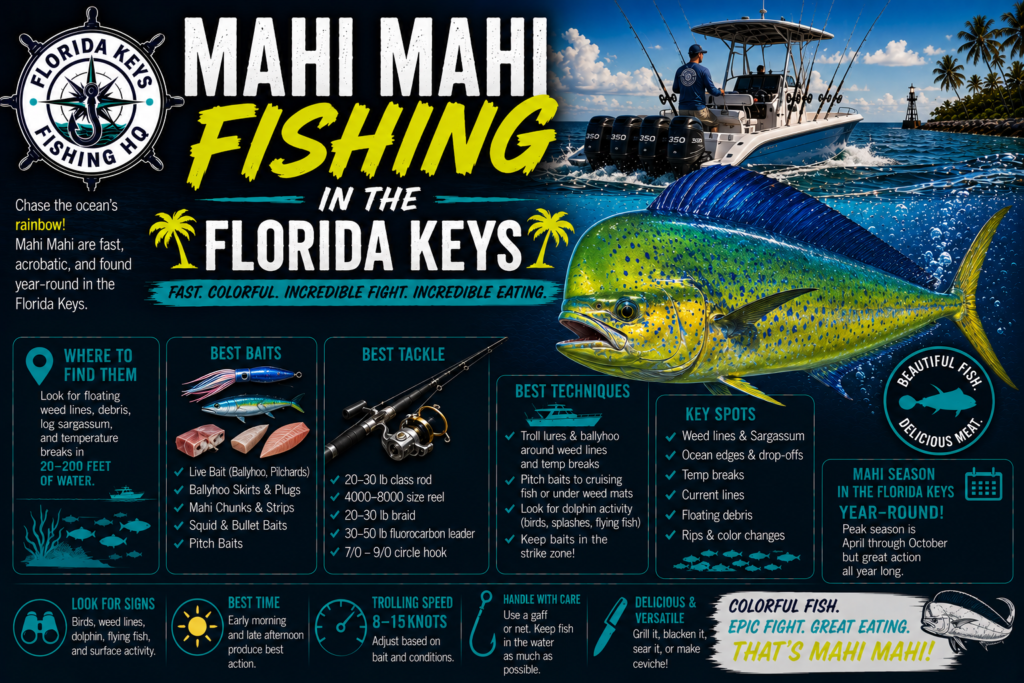
  • Mahi-mahi, also known as dolphin fish or dorado, are one of the most exciting offshore species found in the Florida Keys. Known for their bright colors, acrobatic fights, and excellent table fare, mahi are a favorite target for both recreational anglers and charter captains.

    The Florida Keys provide outstanding mahi fishing opportunities throughout much of the year, especially during the warmer months when offshore conditions are favorable.

    Where to Find Mahi-Mahi

    Mahi-mahi are highly migratory fish that spend most of their lives offshore.

    Productive areas often include:

    • Weed lines
    • Floating debris
    • Current edges
    • Color changes
    • Offshore rips
    • Frigate birds

    Mahi frequently gather around anything floating in the ocean because it provides shade and attracts baitfish.

    Best Time of Year for Mahi-Mahi

    Mahi can be caught throughout the year in the Florida Keys, but the best fishing generally occurs from spring through early fall.

    Many anglers consider:

    • April
    • May
    • June
    • July
    • August

    to be peak mahi season.

    During these months, warm water and favorable offshore conditions often produce excellent action.

    Best Bait for Mahi-Mahi

    Mahi are aggressive feeders and will strike a variety of natural baits.

    Popular choices include:

    • Ballyhoo
    • Pilchards
    • Flying fish
    • Threadfin herring
    • Squid

    Fresh bait often produces the best results when fish are feeding aggressively around weed lines and floating debris.

    Best Lures for Mahi-Mahi

    Artificial lures can be extremely effective.

    Popular options include:

    • Skirted trolling lures
    • Chugger heads
    • Feather lures
    • Soft plastics
    • Surface plugs

    Bright colors such as blue, pink, green, and chartreuse are commonly used by Florida Keys anglers.

    Trolling for Mahi-Mahi

    Trolling remains one of the most effective ways to locate mahi offshore.

    Most anglers troll between:

    • 5 and 8 knots

    while covering water around weed lines, current breaks, and offshore structure.

    A spread of ballyhoo and artificial lures often produces excellent results.

    Finding Weed Lines

    Weed lines are among the most productive mahi habitats in the Florida Keys.

    These floating lines of sargassum weed attract:

    • Baitfish
    • Crabs
    • Shrimp
    • Flying fish

    which in turn attract mahi.

    Many experienced anglers spend significant time searching for productive weed lines before setting lines.

    Frigate Birds and Mahi

    Frigate birds can be valuable indicators of feeding mahi.

    When frigates repeatedly circle or dive in one area, anglers often investigate for bait schools and feeding fish.

    While birds do not guarantee mahi, they frequently point anglers toward productive offshore water.

    Tips for Catching More Mahi

    • Keep a pitch rod ready.
    • Carry live bait whenever possible.
    • Watch for floating debris.
    • Pay attention to water temperature breaks.
    • Slow down when approaching weed lines.
    • Leave one hooked fish in the water when possible to keep the school nearby.

    Many anglers catch multiple fish from a single school by keeping fish interested near the boat.

    Common Mistakes

    Many anglers:

    • Troll too fast
    • Ignore small weed patches
    • Fail to carry pitch baits
    • Overlook current edges
    • Leave productive water too quickly

    Patience and observation are often key to consistent mahi success.

    Final Thoughts

    Mahi-mahi are one of the most exciting offshore fish available to Florida Keys anglers. By focusing on weed lines, floating debris, current breaks, and bird activity, fishermen can dramatically improve their chances of success.

    Whether trolling ballyhoo offshore of Key Largo, searching weed lines near Islamorada, or exploring blue water beyond Marathon, mahi-mahi provide some of the most memorable fishing opportunities available anywhere in Florida.

    Learn how to locate productive offshore water in our Florida Keys Fishing Seasons Guide (2026).